Are All Washing Machines the Same Depth?
No, washing machines are not all the same depth. Front loaders run from about 22 inches to 31 inches deep, while top loaders sit around 25 to 28 inches, so depth varies by brand, type and capacity.
On this page (8 sections)
- How deep is a washing machine?
- Are front load and top load washers the same depth?
- What depth do compact and full-size machines run?
- How do you measure a space for a washer?
- Will a deeper washer fit my laundry closet?
- Does depth affect stackability and side-by-side layout?
- Does a deeper washer mean more capacity?
- Which washing machine depth should you choose?
No, washing machines are not all the same depth. Depth varies by washer type, brand and capacity, from about 22 inches for a compact front loader up to around 31 inches for a large one.
Top loaders usually sit in the middle, near 25 to 28 inches. Measure your space before you shop, because the depth number is the one that decides whether the machine fits.
The width gets most of the attention in a laundry closet, but depth is the measurement that causes trouble. A machine that is a few inches too deep can block a doorway, stop a closet door from closing or push the hoses against a wall.
The models below show how wide the range really is.
How deep is a washing machine?
A typical washing machine is about 27 inches deep. That's the middle of the range for both types.
Compact front loaders come in smaller, around 22 to 23 inches, while full-size front loaders can reach 31 inches or more.
Depth is measured from the back of the cabinet to the front face, without the door or dials. You'll usually see it as one of three numbers, depth by width by height.
That order matters, because the first number is the one you need for your wall. A top loader's cabinet depth is often close to its width.
Front loaders are usually the opposite, deeper than they are wide, because the drum sits behind a front door. That shape changes how the machine sits in a closet or alcove.
Are front load and top load washers the same depth?
No, the two types are built differently. A front loader has its drum behind a front door, so the cabinet runs deep, while a top loader opens at the top and usually has a cabinet closer to square.
The Kenmore 2.2 Cu Ft Compact Front Load Washer measures 22.9 inches deep, 23.5 inches wide and 33.3 inches high. The CONTOURE 24-Inch 2.7 Cu Ft Front Load Washer is 25.2 inches deep.
Both fit a narrow closet better than most top loaders of the same capacity.
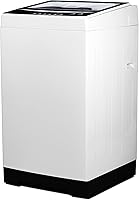
The KoolMore 25-Inch 4.0 Cu Ft Top Load Washer comes in at 25.25 inches deep and 27.75 inches wide. It's a shallower cabinet than many full-size front loaders, but it needs clear space above for the lid to open.
Why does a front loader's depth matter more?
A front loader's door swings out in front of the machine. That swing needs open floor space, so a deep cabinet plus an open door can eat a lot of room in a tight hallway.
The CONTOURE lists a maximum depth of 42.5 inches with the door open. That's the figure to check if your washer sits at the end of a corridor or beside a door you use every day.
Measure the floor in front, not just the wall behind. Top loaders avoid the swing but ask for headroom, so check both the depth behind the machine and the space above it.
What depth do compact and full-size machines run?
Compact machines run roughly 22 to 25 inches deep, and full-size machines about 25 to 31 inches. The extra depth on a full-size model usually buys a bigger drum and more capacity in cubic feet.
The Kenmore at 2.2 cubic feet sits at the small end. It suits a studio apartment, a basement or a vacation home where space is short.
The CONTOURE at 2.7 cubic feet gives you more room for laundry while staying just over 25 inches deep. The KoolMore top loader holds 4.0 cubic feet in a cabinet 25.25 inches deep.
That's a lot of capacity for the depth, which is why top loaders remain popular in family homes with standard closets. For a closer look at capacity against room size, see what size washing machine do I need.
How do you measure a space for a washer?
Measure the depth, width and height of the opening, then add clearance behind and above. Write down the smallest number in each direction, because a doorway or a baseboard can cut the usable space.
Start at the back wall and measure straight out to the front edge of the closet or alcove. Then measure the width between the side walls and the height from the floor to the lowest shelf or counter.
Check the path into the room as well. A machine that fits the closet but not the doorway won't get installed, so measure the door width and any turn in the hallway.
Leave room behind the machine for the inlet and drain hoses. Leave room above a top loader for the lid, and a little air around the cabinet so the motor doesn't run hot.
How much clearance does a washer need?
Plan for about 1 to 2 inches behind the cabinet and the same above a top loader. A front loader also needs floor space in front for the door to swing.
If your closet is exactly as deep as the washer, the hoses will press against the back wall and the machine may not sit flat. A slight gap also keeps vibration from rattling the cabinet against the wall.
For stackable models, measure the combined height of the washer and dryer. The Kenmore and CONTOURE both stack with compatible dryers, so the floor footprint stays small but the stack gets tall.
Will a deeper washer fit my laundry closet?
Often yes, but only if the closet is deeper than the machine plus the hoses. A standard laundry closet is about 27 inches deep, which leaves room for many top loaders and compact front loaders.
A full-size front loader near 31 inches deep may not close a 27-inch closet door. If the closet sits in a hallway, the extra inches could also block traffic, so measure the open floor in front before choosing that size.
A 24-inch deep closet is tight. A compact front loader like the Kenmore at 22.9 inches leaves only about an inch for hoses, so check where the plumbing sits.
A top loader in that closet would need the hoses routed to the side.
If your closet is shallow and your family is small, a compact front loader is the safer fit. Our guide to the best washing machine for an apartment covers the models built for small footprints.
Does depth affect stackability and side-by-side layout?
Yes, matching depths keep a stack or a pair fitting cleanly. A washer and dryer of different depths can leave a shelf of wasted space or a cabinet that sticks out past its partner.
The Kenmore is stackable, so it can sit under a compatible dryer in the same footprint. The CONTOURE also stacks with compatible dryers.
That saves floor space in a small laundry area, though the stack gets tall. For a side-by-side pair, matching the depth of the two machines keeps the front faces flush.
If your dryer is deeper than your washer, the pair may not close behind a bifold door. Measure both units before you commit to the layout.
A top loader can't be stacked, so it needs its own floor space. That matters in a narrow closet where the only way to fit both machines is a stack.
Does a deeper washer mean more capacity?
Usually yes, within the same type. A deeper drum holds more laundry, and capacity in cubic feet tends to grow with cabinet depth, though the link isn't exact because drum design takes up space too.
The KoolMore top loader shows the pattern from the other direction. Its 25.25-inch cabinet holds 4.0 cubic feet, more than the 2.7 cubic feet of the CONTOURE at a similar depth, because an agitator model uses its drum differently from a front loader.
Capacity also decides how many loads you run each week. A 2.2 cubic foot compact machine handles smaller, more frequent loads, while a 4.0 cubic foot top loader takes bigger family loads less often.
More capacity means fewer cycles, which can offset the deeper cabinet. Water hardness is another factor in how well any machine cleans, so if your area has hard water, read which washing machine is best for hard water before you pick a type.
Which washing machine depth should you choose?
Choose the deepest machine that fits your space with clearance to spare. Start with the closet or alcove depth, subtract 2 inches for hoses and airflow, and shop within that limit, then match the capacity to your household.
A compact front loader is the pick for a shallow closet or an apartment. The Kenmore at 22.9 inches deep suits one or two people and stacks with a dryer.
The CONTOURE at 25.2 inches deep gives you 2.7 cubic feet and still fits many tight spaces. A top loader is the pick when you have floor space but need family-size capacity.
The KoolMore at 25.25 inches deep holds 4.0 cubic feet and opens at the top. It won't stack, so plan its spot on the floor.
Depth is not the only number to check. Width and height decide whether the machine clears the doorway and the shelf above.
Use our how to choose a washing machine guide to compare all three against your room.
Before you buy, measure the opening twice and write the figures down. A machine that clears the back wall with an inch to spare will install without forcing the hoses.
If you're short on room and want a compact unit, start with the apartment picks linked above. And if your heart is set on a full-size front loader, check the door swing as well as the cabinet depth.
Are all washing machines the same depth? No, they aren't, and your tape measure decides which one works.
Frequently asked questions
Are all washing machines the same depth?
No. Depth changes with the washer type, capacity and brand.
Compact front loaders can be about 22 to 23 inches deep, while full-size front loaders reach around 31 inches and top loaders about 25 to 28 inches.
What is the most common washing machine depth?
Most top loaders land near 27 inches deep, and many full-size front loaders sit between 25 and 31 inches. A standard laundry closet is about 27 inches deep, so a machine near that figure fits many homes without a big gap.
Does a front load washer fit in a 24-inch deep closet?
A compact front loader near 22 to 23 inches deep can fit a 24-inch deep closet, but the door and hoses need room behind. Leave clearance for the inlet and drain lines, and keep the door open after a wash to dry the drum.
Why do top loaders need extra depth behind them?
Top loaders often need clearance behind the cabinet for the water hoses and the lid hinge. Depth figures usually measure the cabinet alone, so add a couple of inches behind for plumbing and airflow.
Does washer depth affect how much laundry I can wash?
Yes, depth usually tracks with drum size. A deeper machine often holds a larger drum and a bigger capacity in cubic feet.
A compact 2.2 cubic foot model suits one or two people, while a 4 cubic foot top loader handles family loads.